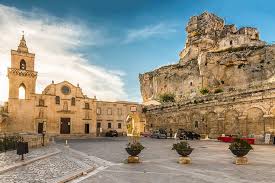
| Churches in Matera and Rupestrian Churches |
There are several churches along the city roads. Inside the Sassi districts you can also see 155 rupestrian churches, rupestrian meaning excavated out of the rock.
You can read below about some most famous churches in the town.
|
| Cathedral |
It is one of the most famous sacred monuments in the town. Its building was started in the first 1200. The church is completely made of the tufa stone excavated out of the Lavaglia cava. It stand over the whole town and its façade has got a front door entering the nave. Inside the Cathedral they keep various statues of Saints, among which you can find La Madonna della Bruna, Saint Patroness of the town.
It has a Latin cross shape and it is divided into three parts (the nave is the highest) and in ten medieval figurative capitals. Among the several frescos, you can see Il Giudizio Universale (the Final Judgement) dated back to the Medieval Times.
You can also find a Christmas Crib built in the first decade of 1500.
|
| Chuch San Domenico |
IT has a Romanic façade where you can find an elegant rose-window called “wheel of fortune”. Inside the wheel a dog is holding a torch in its mouth thus representing the Dominican order while around the wheel there is a Telamone in the lowest part, two deacons on both sides and San Michele Archangel on the top.
The church is divided into nave and aisles and it has undergone various changes such as the stucco decorations of the walls and the building of the Chapel of the Rosario. Inside the church you can find important masterpieces like the high altar with a statue in papier maché representing the Rosario Holy Maid, on the paintings and an organ dated 1600.
|
| Chiesa del Purgatorio |
It is one of the most beautiful churches in late baroque style built in the first half of 1700. Its particular convex façade deals with the theme of death, of the fugacity of life and of the redemption of the souls. On the top you can see the statue of the Madonna with the Child. The door made of wood is divided in 36 panels representing skulls of sovereigns or prelates who died in some other Italian towns. On both sides of the façade, there are the statues of San Michele Archangel and the Angelo Costode. Very important is octagonal the chapel decorated with the images of the four Evangelists and of the four doctors of the Church. On the canvas on the high altar San Gaetano is represented who is interceding with the Madonna for the souls of the Purgatory. Inside this church an organ dated 1600 is kept together with eight canvases dated back to the 18th century.
|
| Chiesa di Santa Maria della Palomba |
The church can be reached following the Appia road in the outskirts of Matera. It was built in the 16th century on a cliff falling sheer to the Gravina. Its façade is divided in two different orders and is signed by high pilaster strips forming three blind arches. The portal in stone with lowered arch is overhung by an high-relief made in tufa stone representing the Sacred Family. On the top there is an elegant stone rose-window overhung by a niche welcoming the statue of Saint Michele. On the right a bell gable stands. The inner walls are completely frescoed and contain a series of niches with statues of Saints and tondos with paintings. In the sculptured altar-piece there are two niches with some statues and a fresco of The Virgin with the Child. Beside the built part dated back to 1500, next to the church there is a completely excavated part dated back to 1000 A.D. showing ancient and well-kept frescoes.
|
| San Pietro Caveoso |
It stands in the centre of the Sassi district on the homonymous square. It was built in the 17th century on a pre-existent cult site and it was then re-made in 1700. On the façade there are three rectangular portals overhung by three statues in stone. On the left side there is a majestic bell-tower on a squared plan. Inside there are nave and aisles with small lateral chapels on the left. The plain roof of the nave is in painted wood. On the high altar a polyptych stands representing the Madonna with the Child and Saints Peter e Paolo. Inside other statue are kept such as the Madonna with the Child and some frescos of 1400 telling episodes about the Saints’ lives.
|
| Rupestrian Churches |
The use of caves as home can be dated back the dawn of human civilization, according to archaeological researches.
Men have soon learned to use these caves according to their needs and to design the spaces around them and build sites making their lives more comfortable.
Throughout the centuries the town saw Byzantine, Longobard, Imperial and Saracen arms which, beside being bellicose, transmitted the local people all their values, culture and faith.
History has though designed the town identity with a melting pot of civilizations giving life to a unique life system. The need to gather in a urban context and to create cult sites progressively became more urgent. As a consequence, some frescoes representing Angels and Saints began to appear in the caves and some authentic churches were built. Together with an increasing number of homes, gathered together into “Vicinati”, a series of churches began to emerge which are now called rupestrian because carved out of the rocks and partially built according to the religious needs.
Nowadays you can see several churches scattered in the Sassi districts: there are more then 115 churches and crypts carved out of rock, many of which are still to be recovered.
Below you will read about some churches which are open and can be visited by the public.
|
| San Pietro Barisano |
It is the most representative church, which best summarizes the ‘wedding’ of an excavated part and a built one. It derives its name from the younger district of the Sassi. From the outside, you can look at a campanile on the left side of the church sited on a rock plane, which has then been reinforced with a basis to prevent it from falling over the underlying homes. The façade, built in tufa stones, has a very simple architecture which makes it elegant.
Inside the church is divided in simple nave and aisles composed by pillars with a squared shape and united by round arches. Each aisle has an altar and some book shields and the high altar stands in the nave.Very important works stand inside the church, such as L’Incoronazione della Beata Vergine with Apostles Peter and Paolo, the Cristo nel Sepolcro and the Altare dell’Annunciazione.
|
| The Crypt of the Original Sin |
On the Appia road towards Miglionico (km 567) soon after the deck over the Torrente Gravina, you can follow the first lane in the right and then go straight till the end of it. A narrow stairs leads down to the places where the church of the Original Sin stands, more famous as La Grotta dei Cento Santi.
The plain rectangular shape is poor in architecture (you can only look at three wide niches on the left wall) but it is rich in painting elements creating a cycle on the right and at the walls end.
The wall end is divided in three sectors with the letter PAX and is covered by the Cristo Redentore image. On the left side the Biblical episode of the Original Sin develops while on the right side the Avvento delle Tenebre e della Luce scenes takes place. Further down the liturgical purification of a bishop is represented. On the left wall the three apse niches contain other triarchies. The first represents Saint Peter with Saint Andrew and Saint John. The second shows the Madonna and the Child adored by two women. The third represents the Arcangels triarchy.
The plain wall over the apses was once rich in decorations but you can now only some illegible fragments. In the inner side, much ruined, you can look at the Christ with crossed nimbus holding a dark globe in his left hand. By his side is the Archangel Gabriel on his knees, in adoration act.
|
| La Madonna de Idris |
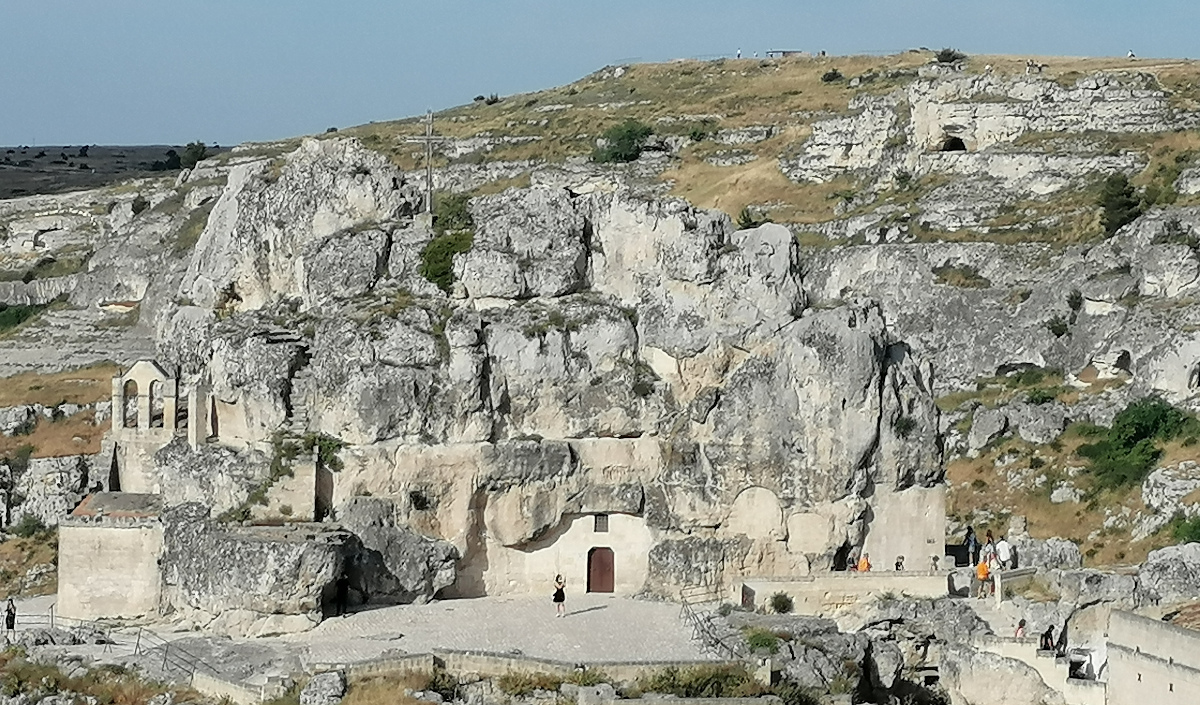
Going in the heart of the Sassi e looking towards the town, with the Gravina on your back, you can notice a big rock with a cross on its top. Going upstairs among small homes you will reach the entrance of Madonna de Idris. The church, made up by very irregular isles, is one of the most charming in the ancient town.
It is a small church partly built and partly excavated on the top of Monterrone, the picturesque calcareous rock stands in the middle of the Sasso Caveoso.
The built part, where you can recognise some gothic elements, is very poor in architecture but is covered with frescoes or painted a tempera.
Beside an ancient altar and a stone statue representing Saint Leonard, there is nothing left to be seen of its primitive structure but some fragments of frescoes which must have covered the whole site.
The chapel on the right is illuminated by a small squared picture representing Christ Crucifisso on a Renaissance town. On the same wall some other figures are represented such as the Madonna, the Annunciazione, Saint John, Saint Leonard, a Madonna dell’Umiltà and the Virgin with the Blessing Child with a white dove on her left.
|
| Madonna delle Tre Porte |
On the Murgia Timone, at 300 metres from Sant’Agnese Crypt, you can find the sanctuary of Madonna delle Tre Porte. The original entrance has completely fallen down. The inside has a pseudo-rectangular shape with the minor sides symmetrically opposed and with three apse holes.
Four heavy pillars must once have limited the hypogean space: they are all connected by thick parabolic arches which are enhanced on a plain roof. There is no trace of altar, but the crypt is decorated by numerous graffiti and frescoes and some rare niches.
For further information:
The Rupestrian Churches in Matera by the Cultural Club La Scaletta.
MATERA the Rupestrina Churches by Franco Di Pede.
|